
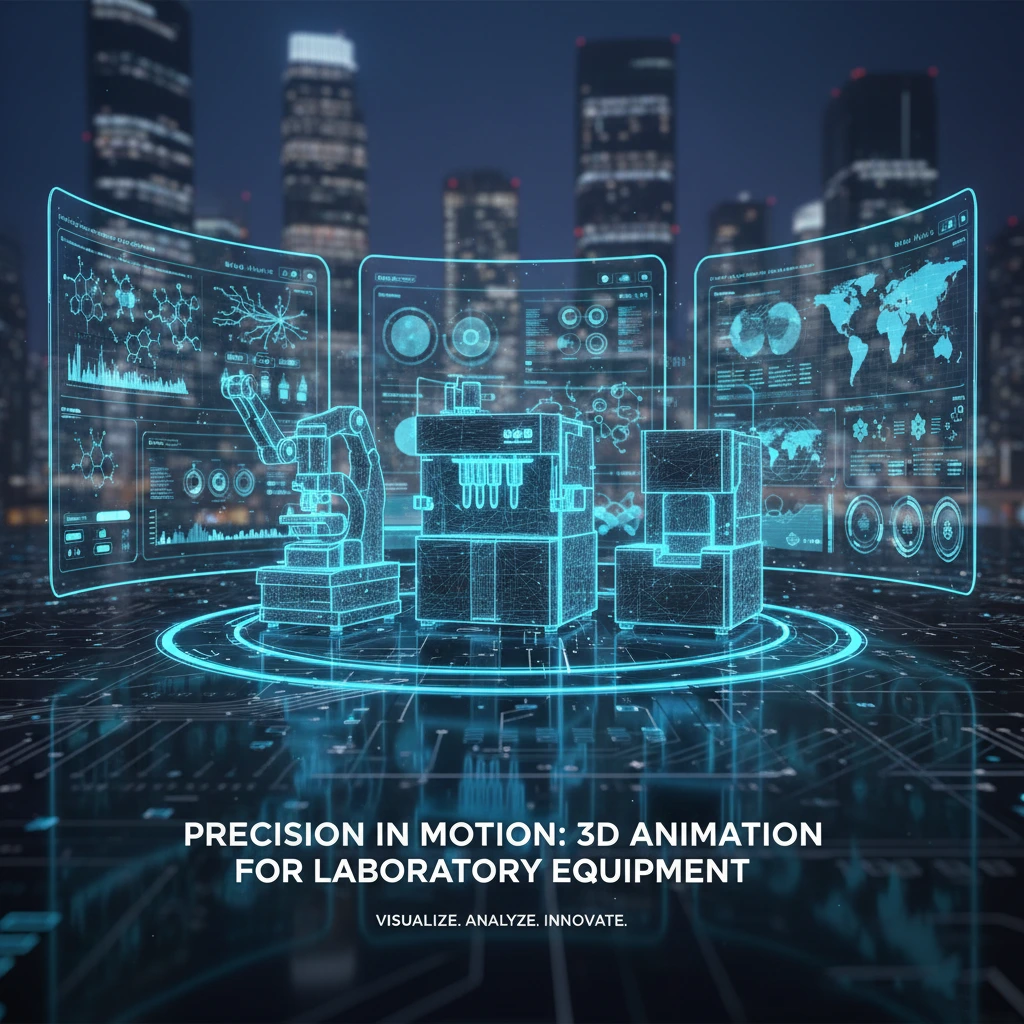
Precision in Motion: 3D Animation for Laboratory Equipment
Selling laboratory equipment is not about selling hardware it is about selling data accuracy. Whether it is a high speed centrifuge, a mass spectrometer, or an automated liquid handler, researchers need to trust that the machine delivers precise results every time.
A static photo of a white box cannot show 40,000 RPM Stability or Nanometer Precision.
To demonstrate the reliability of scientific tools, brands like Thermo Fisher and Beckman Coulter rely on 3D Technical Animation. Here is how 3D helps you visualize the science of precision.
1. Inside the Analysis (The Invisible Beam)
How does a spectrometer identify chemicals? It uses invisible light or lasers.
3D animation makes the analysis visible.
- The Beam: Visualize the laser beam hitting the sample.
- The Diffraction: Show the light splitting into a spectrum (rainbow) inside the machine.
- The Sensor: Visualize the detector capturing the unique optical signature of the substance, turning light into data.
2. High-Speed Mechanics (Centrifugation)
Centrifuges spin at dangerous speeds. Customers worry about vibration and sample safety.
3D animation allows for a Slow Motion X-Ray.
- The Spin: Show the rotor spinning at 100,000 RPM while remaining perfectly balanced.
- The Separation: Zoom inside the test tube to show the blood or DNA separating into distinct layers (sedimentation) due to centrifugal force.
- Safety Locks: Highlight the heavy-duty locking mechanism that keeps the user safe during operation.
3. Visualizing Lab Automation (Robotics)
Modern labs are automated. Robots move samples to reduce human error.
Filming a robot moving clear liquid in a clear plate is visually boring. 3D animation adds clarity.
- Liquid Handling: Zoom in on the pipette tip dispensing exactly 1 microliter of glowing fluid without splashing.
- Throughput: Animate the robotic arm processing 96 samples in under a minute to prove speed.
- Contamination Control: Show the HEPA filtered airflow creating a sterile curtain around the samples.
4. Modular Lab Configuration
Labs come in different sizes. Buyers need to know if your system fits their benchtop.
3D animation creates a Virtual Lab.
- The Setup: Show the equipment being configured with different modules (e.g., adding a heater or a shaker).
- Footprint: Visualize how compact the machine is compared to a standard laptop or workbench.
- Scalability: Show a single unit expanding into a daisy chained system for high-volume labs.
5. Software Interface Simulation
The hardware is only as good as the software. Researchers want an easy-to-use interface.
3D animation integrates the UI seamlessly.
- The Dashboard: Show the touchscreen interface floating next to the machine.
- Real-Time Data: Visualize the graph on the screen generating in sync with the internal mechanical action.
- Error Handling: Demonstrate the system detecting a missing vial and alerting the user instantly.
Conclusion
Science relies on evidence. Your marketing should provide visual evidence of your equipment’s capability. 3D animation allows you to look inside the machine and the sample, proving that your technology delivers the precision researchers demand.
Multiverzz Studio creates precise, scientific 3D animations for the laboratory and research industry. Visualize your accuracy. Contact us today.