
Photography vs 3D Rendering: The Real Winner for E-commerce
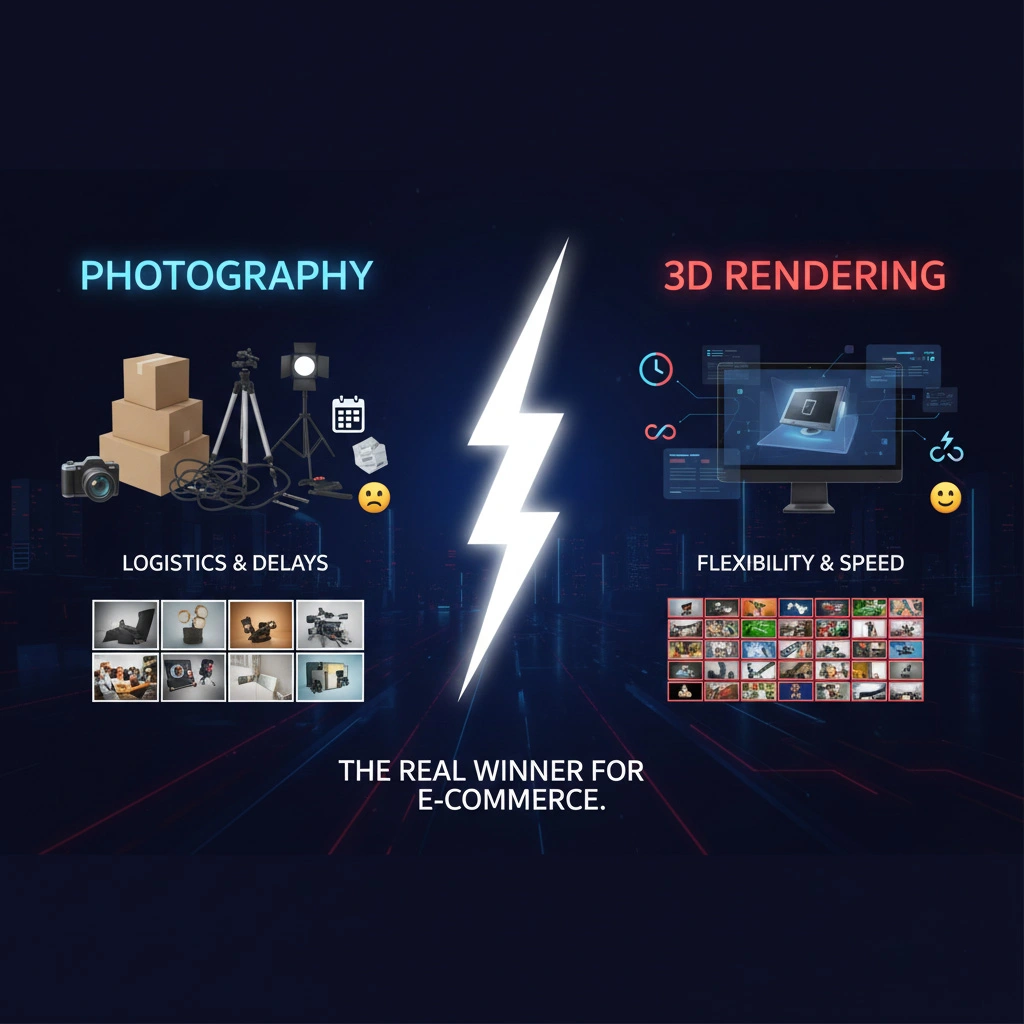
For decades, traditional photography was the only way to showcase products. E-commerce sellers would ship samples to a studio, hire a professional photographer, set up lighting, and wait for the edited results.
However, the rise of Computer-Generated Imagery (CGI) has disrupted this standard. Today, major brands like IKEA and Apple rely heavily on 3D rendering instead of traditional photos.
If you are an e-commerce brand or Amazon seller, you might be wondering: should you stick to the camera or switch to 3D? Here is a deep dive into the pros and cons of both, and why 3D rendering is quickly becoming the industry standard.
1. Logistics and Simplicity
Photography: Traditional photography is logistically heavy. You must manufacture a physical prototype, package it, ship it to a studio, and hope it arrives undamaged. If the product has a scratch or a smudge during the shoot, the image is ruined or requires heavy retouching.
3D Rendering: 3D rendering is 100% digital. You do not need a physical product. If you have the CAD files or even just reference images with dimensions, a studio like Multiverzz can create a photorealistic model. This eliminates shipping costs, delays, and the risk of physical damage.
2. Flexibility and Variations
Photography: Imagine you sell a water bottle in five different colors. With photography, you need to ship all five bottles and shoot them individually. If you decide later to add a sixth color, you have to restart the entire process, hoping the lighting matches the previous session.
3D Rendering: In the 3D world, changing color, texture, or material takes minutes. Once the master model is created, generating variations is fast and cost-effective. You can render the same product in a forest, a kitchen, or a clean white background without ever leaving the software.
3. Perfect Consistency
Photography: Achieving consistent lighting and angles across a product catalog is notoriously difficult with cameras. Slight changes in studio setups can make your brand look unprofessional when images are placed side-by-side on a collection page.
3D Rendering: Computers offer mathematical precision. You can set up a virtual lighting environment and apply it to hundreds of products. This ensures that every shadow, reflection, and angle is identical, giving your Amazon listing or website a sleek, cohesive look that builds trust.
4. Visualizing the Impossible
Photography: Cameras are limited by physics. Photographing the inside of a machine, a cross-section of a mattress, or the internal wiring of a gadget requires destroying the product or building expensive custom props.
3D Rendering: This is where 3D truly shines. You can create “impossible shots” such as:
- Cutaways: Slicing a product in half to show internal layers.
- Ghost Views: Making the outer casing transparent.
- Microscopic Details: Zooming in on fabric weaves or metal textures that a macro lens might miss.
These visuals are crucial for technical products where the value lies inside the casing.
5. Cost and Scalability
Photography: While entry-level photography can be cheap, high-end commercial photography is expensive. Costs pile up with shipping, prop rentals, model hiring, and studio time.
3D Rendering: Initially, creating a high-quality 3D model might seem like an investment. However, the long-term ROI is massive. That single model can be used for static images, 360-degree spins, and even full animation videos later on. It is an asset that you own and can reuse indefinitely without re-shooting.
The Verdict
Traditional photography still has its place, particularly for lifestyle shots involving human emotion and natural unpredictability. However, for product-focused e-commerce imagery, especially on platforms like Amazon. 3D rendering offers superior flexibility, consistency, and speed.
If you want to scale your brand without the logistical headaches of photo shoots, 3D is the clear winner.
Multiverzz Studio specializes in turning simple concepts into photorealistic 3D assets. Skip the shipping and studio costs—let us build your product virtually. Contact us for a quote today.