
Why Static Images Are Dead: The Rise of 3D Motion
The internet is noisy. In the early days of digital marketing, a high quality photo was enough to stop someone from scrolling. Today, the average user scrolls through 300 feet of content every day the height of the Statue of Liberty.
In this endless stream of visual data, the static image has lost its power. It blends into the background.
To capture attention in 2024 and beyond, brands are shifting to 3D Motion. Whether it is a looping 3D animation, a product spin, or a motion graphic ad, movement is the new currency of engagement.
Here is why static images are fading away and why 3D motion is taking over.
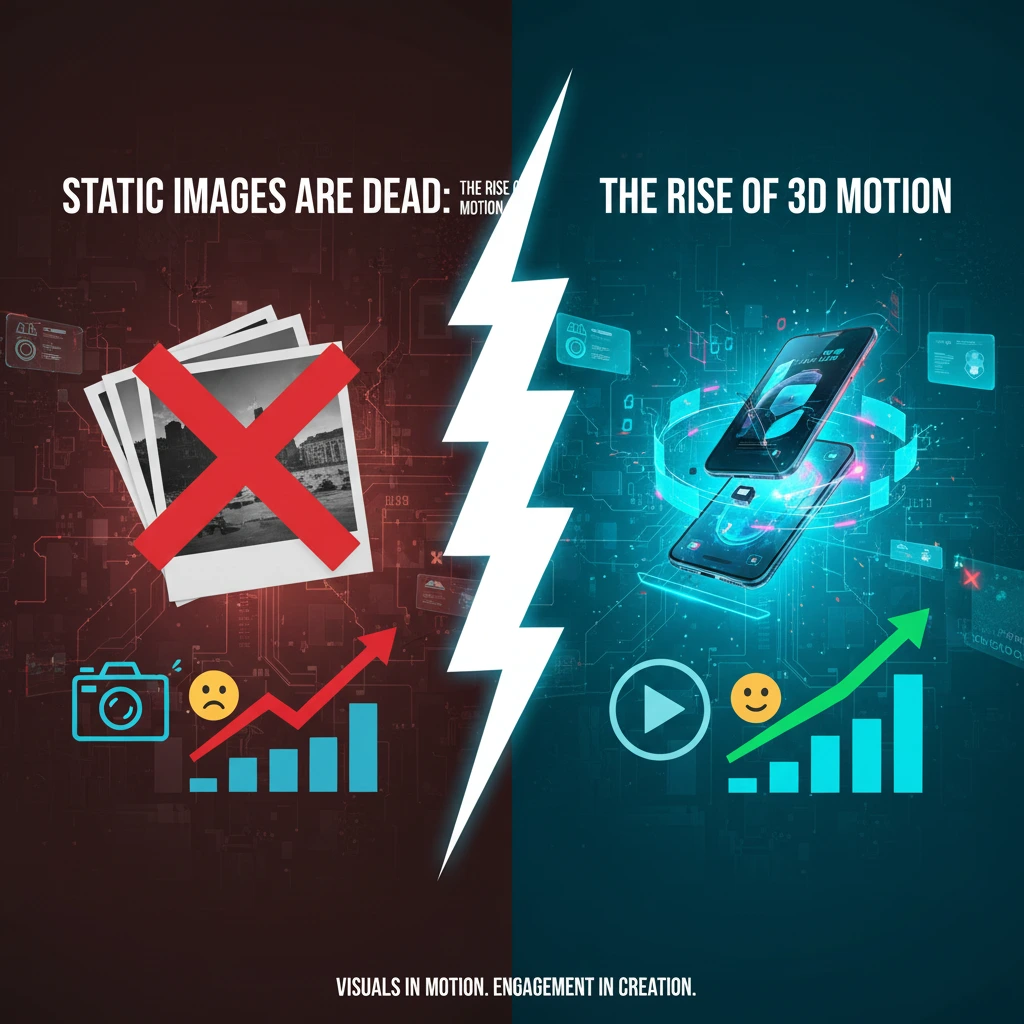
1. The “Pattern Interrupt” Effect
Our brains are wired to ignore static backgrounds but instantly detect motion. It is an evolutionary survival trait.
When a user is doom-scrolling through Instagram or LinkedIn, their brain filters out static images as “noise.” However, the moment an object spins, floats, or disassembles on screen, the brain signals a “Pattern Interrupt.”
3D motion forces the user to pause. Even a simple 3 second loop of your product floating in zero gravity can increase dwell time significantly compared to a flat JPEG.
2. Information Density
A picture says a thousand words, but a video says a million.
With a static image, you can only show one angle at a time. To show the back, side, and interior of a product, you need a carousel of 5 to 6 images. Users rarely swipe through all of them.
3D motion delivers high “Information Density.” In a single 10 second animation, you can:
- Rotate the product 360 degrees.
- Explode the view to show internal parts.
- Demonstrate the product in action.
You convey the entire value proposition without asking the user to click or swipe.
3. Algorithm Bias Toward Video
Social media platforms like Instagram, TikTok, Facebook, and LinkedIn have officially declared themselves “Video First” platforms.
Their algorithms are designed to prioritize content that keeps users on the app longer. Since users spend more time watching a video than looking at an image, algorithms naturally push video content to more feeds.
By sticking to static images, you are fighting against the algorithm. By switching to 3D motion ads, you are riding the wave of organic reach.
4. Higher Click Through Rates (CTR)
Data consistently shows that video ads outperform static image ads.
- Facebook: Video ads have an average CTR that is 2-3 times higher than static image ads.
- Email Marketing: Including a GIF or motion element in an email increases click rates by up to 300%.
3D motion graphics look premium and expensive, which builds subconscious trust. A user is more likely to click on a sleek, high-end 3D animation than a generic stock photo.
5. Emotional Storytelling
Static images are passive; motion is active.
With 3D animation, you can control the mood through lighting changes, camera movements, and pacing. You can create a sense of excitement, luxury, or technological superiority.
For example, a static photo of a watch is just a watch. But a 3D animation showing the gears turning, light glinting off the sapphire glass, and the strap locking into place creates a feeling of precision and desire.
Conclusion
The era of the static image is not over, but its dominance is. For landing pages, ads, and social media, 3D motion is no longer just a “nice to have” it is essential for survival.
If you want your brand to be seen, you must move.
Multiverzz Studio creates high impact 3D motion graphics that stop the scroll. Ready to animate your brand? Contact us today.