
Showcase Building Materials with 3D Animation
Selling building materials and industrial products is not like selling sneakers. You are not just selling a look; you are selling technical performance, durability, and ease of installation.
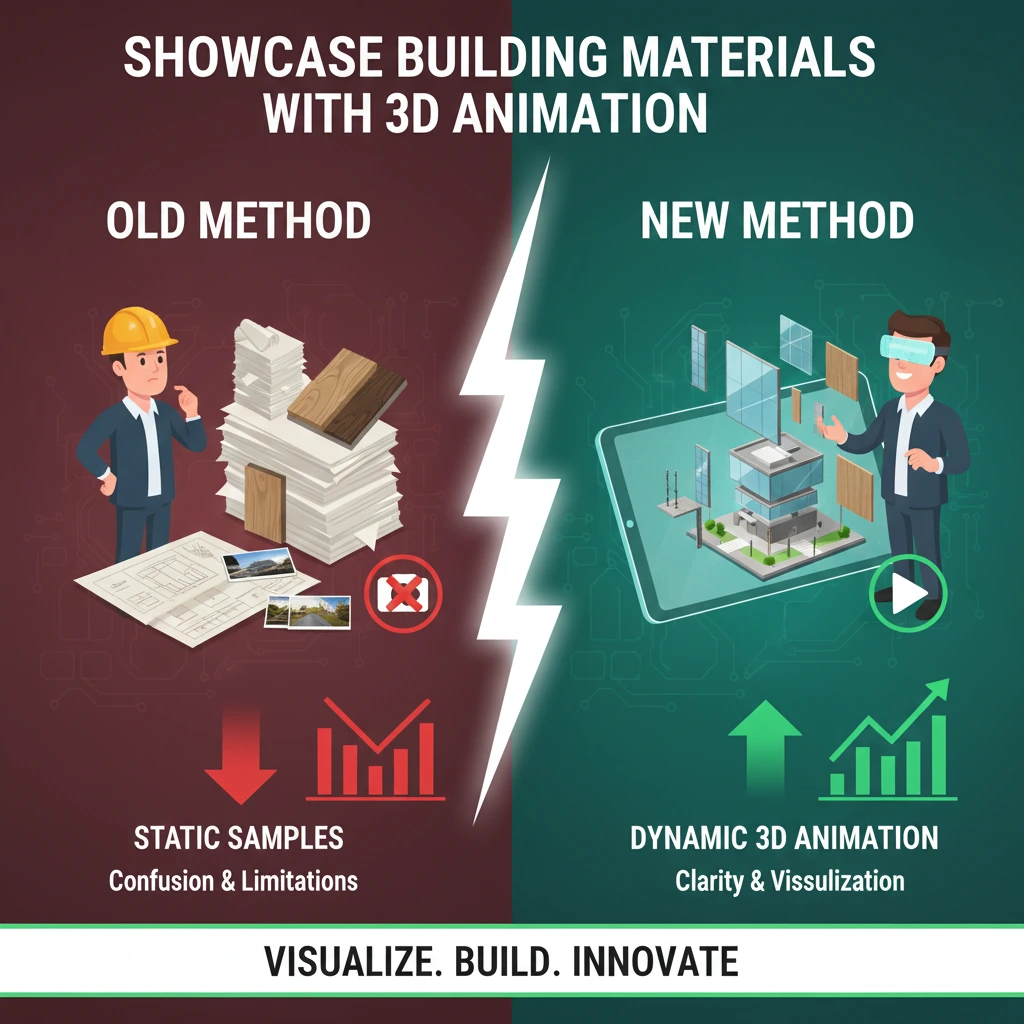
For decades, sales reps have hauled heavy physical samples to construction sites or relied on flat brochures to explain complex layering systems. This method is slow, expensive, and often ineffective.
In the digital age, 3D Animation is transforming how industrial brands showcase their products. Instead of just telling clients how good your material is, you can now show them exactly how it works.
Here is why top manufacturers are switching to 3D.
1. Visualizing Hidden Layers
Most building materials like insulation, roofing membranes, or acoustic panels derive their value from what is inside. A photo of a finished wall tells you nothing about the technology behind it.
3D Animation allows you to create Cross-Section Views. You can peel back the layers of a wall or floor to reveal:
- The core material composition.
- Weatherproofing barriers.
- Thermal insulation properties.
By visually dissecting the product, you prove its quality without saying a word.
2. Simplifying Installation Training
Improper installation is the leading cause of product failure in the construction industry. When contractors install your product incorrectly, the client blames your brand, not the installer.
A 3D installation video is the ultimate training tool. Unlike live action video, which can be obstructed by a worker’s hands or tools, 3D animation offers a perfect, unobstructed view. You can:
- Show how joints lock together with X-ray transparency.
- Highlight adhesive application areas in bright colors.
- Demonstrate the correct sequence of assembly.
This reduces on site errors and protects your brand reputation.
3. The End of Heavy Samples
Shipping physical samples of bricks, tiles, or steel beams to potential clients is a logistical nightmare and a massive expense.
While physical samples will always have a place, a high fidelity 3D digital twin can do 80% of the work. A sales rep can pull up a tablet and show a photorealistic 3D model that the client can rotate, zoom, and inspect from every angle. It speeds up the sales cycle and reduces shipping costs.
4. Demonstrating Durability and Physics
How do you prove your roofing tile is fire resistant or your glass is shatter proof without staging a dangerous live demo?
3D simulation can visualize physics and environmental factors safely. You can animate:
- Water repelling off a waterproof coating.
- Heat reflection from a thermal barrier.
- Load-bearing capacity of a steel structure.
These visualizations make abstract technical data feel real and tangible to the buyer.
5. Marketing Consistency
If you have a catalog of 50 different flooring types, photographing each one in a real room setting is prohibitively expensive.
With 3D rendering, you can create one “Master Room” scene and swap out the flooring textures instantly. This ensures every product image has consistent lighting and angles, making your catalog look professional and cohesive.
Conclusion
In the industrial sector, clarity is king. Your clients architects, engineers, and contractors need to understand exactly what they are buying and how to install it. 3D animation delivers this clarity instantly, making it the most powerful sales tool in your arsenal.
Multiverzz Studio specializes in technical 3D animation for the construction and industrial sectors. Let us visualize your product’s strength. Contact us today.