
Launch Success: 3D Animation for Aerospace & Space Tech
The aerospace industry deals in the impossible. You are selling satellites that haven’t launched, rockets that haven’t been built, and missions to planets we haven’t visited yet.
You cannot hire a camera crew to film a satellite deploying its solar panels in orbit. You cannot film the internal combustion of a rocket engine during lift off.
To sell these billion dollar visions to governments and investors, the space industry relies on 3D Technical Animation. Here is how 3D helps you visualize the final frontier.
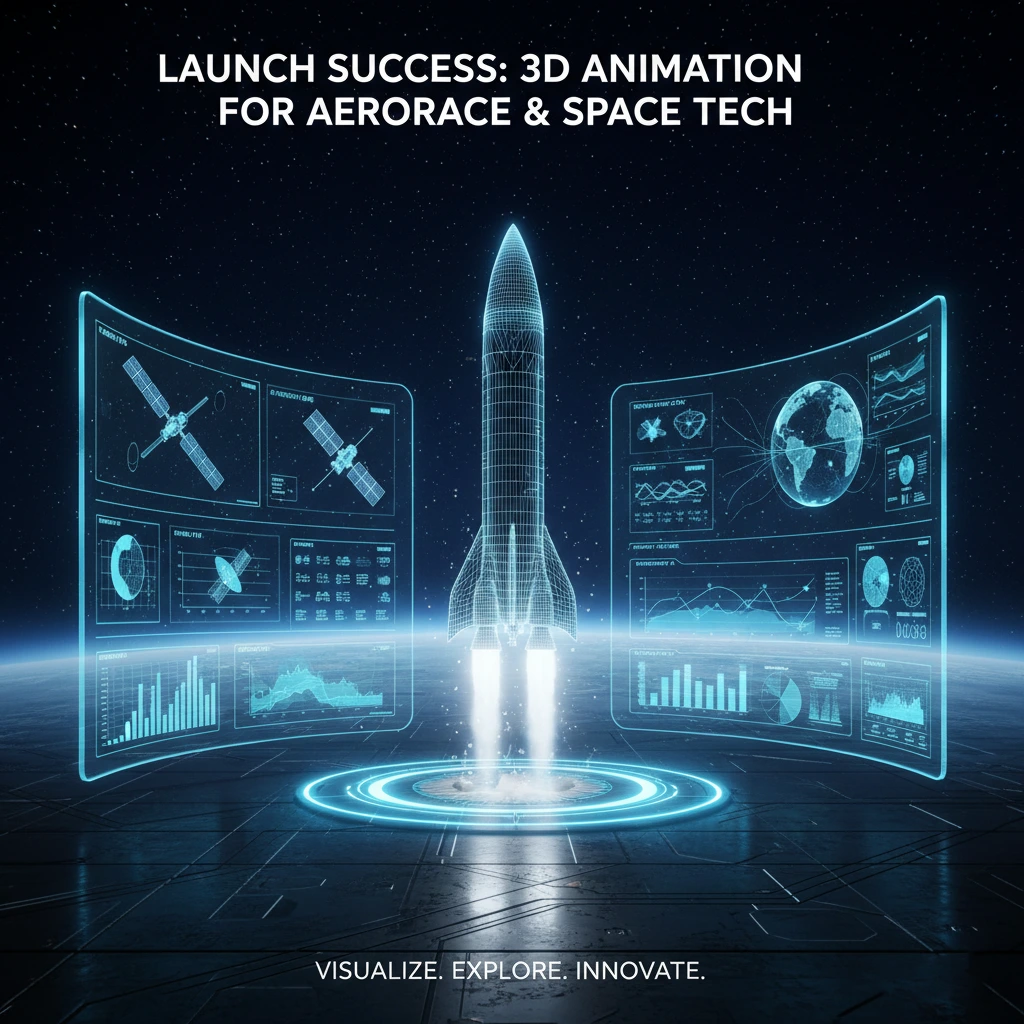
1. Visualizing Orbital Mechanics
“Geostationary Orbit” vs. “Low Earth Orbit (LEO)” these are complex concepts for non-engineers. Investors need to see the path.
3D animation makes the mission trajectory visible.
- The Launch: Visualize the rocket stages separating perfectly in the upper atmosphere.
- The Orbit: Show the satellite entering its specific orbital plane with glowing trajectory lines.
- Docking: Simulate the delicate autonomous docking procedure with the International Space Station (ISS) to prove precision.
2. Inside the Rocket Engine (Propulsion)
Rocket engines are plumbing nightmares. Fuel pumps, oxidizers, and combustion chambers.
3D animation peels back the titanium skin.
- Fuel Flow: Show the cryogenic liquid oxygen (Blue) and kerosene (Red) mixing in the combustion chamber.
- The Ignition: Visualize the spark and the controlled explosion generating thrust.
- Cooling: Show the regenerative cooling channels keeping the nozzle from melting under extreme heat.
3. Satellite Deployment Mechanics
The most critical moment for a satellite is Deployment. If the panels don’t unfold, the mission fails.
A Deployment Simulation proves reliability.
- The Fold: Show the satellite packed tightly inside the rocket fairing (Origami style).
- The Release: Animate the fairing opening and the satellite ejecting into space.
- Unfurling: Visualize the solar arrays and antennas unfolding smoothly in zero gravity to start generating power.
4. Surviving the Harsh Environment
Space is brutal. Extreme heat, extreme cold, and radiation. Clients need to know your hardware will survive.
3D simulation provides a Thermal Stress Test.
- Sun Side: Show the spacecraft facing the sun, with thermal shielding reflecting 200°C heat.
- Dark Side: Show the heaters activating as the craft passes into the Earth’s shadow (200°C).
- Re-Entry: Visualize the heat shield glowing red hot as the capsule re-enters the atmosphere, proving crew safety.
5. The “Big Picture” Constellation
New space startups are launching Constellations (networks of hundreds of satellites).
It is impossible to film a network. 3D animation creates a Global View.
- The Grid: Zoom out to show the Earth surrounded by your network of satellites.
- Coverage: Visualize the data beams covering the entire globe, proving that your service creates universal internet access or weather monitoring.
Conclusion
In aerospace, you are selling a future that doesn’t exist yet. 3D animation is the only way to make that future look real, tangible, and achievable. It turns complex engineering data into a cinematic mission that inspires the world.
Multiverzz Studio creates mission-critical, physics accurate 3D animations for the aerospace and defense sectors. Launch your vision with us. Contact us today.