
The Brains Inside: 3D Animation for Semiconductor Brands
Semiconductors are the oil of the 21st century. From smartphones to fighter jets, chips power our world. But marketing these microscopic marvels is a unique challenge.
How do you sell something that is smaller than a fingernail and hidden deep inside a device? A photo of a black square chip tells no story. It cannot convey 3 Nanometer Precision or Neural Processing Power.
To visualize the invisible intelligence of modern computing, tech giants like Intel, NVIDIA, and AMD rely on 3D Technical Animation. Here is how 3D helps you visualize the brains inside the machine.
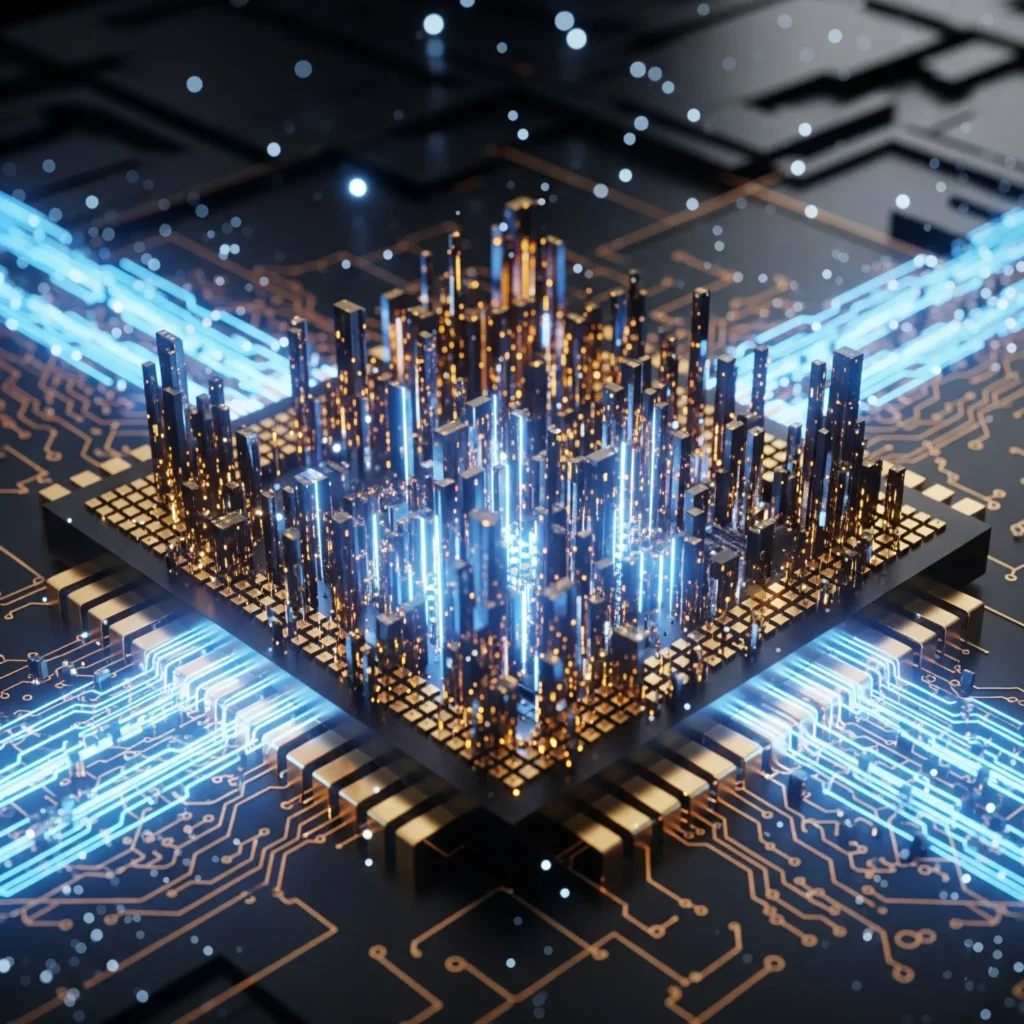
1. Visualizing the Nanoscale (3nm Process)
Modern transistors are measured in nanometers (nm). They are invisible to the naked eye and even to standard microscopes.
3D animation takes the viewer into the quantum realm.
- The Landscape: Create a glowing, futuristic city like landscape representing the billions of transistors on a wafer.
- The Scale: Zoom from a human hand down to the atomic level to demonstrate the impossible precision of your manufacturing process.
- The Gate: Visualize the Gate All Around (GAA) architecture controlling the flow of electrons perfectly.
2. Architecture Reveal (The Floorplan)
A chip is not just one block, it is a complex map of cores, cache, and controllers.
3D animation creates a Digital Flyover.
- The Cores: Highlight the Performance Cores (P-Cores) for speed vs. Efficiency Cores (E-Cores) for battery life.
- The NPU: Visualize the Neural Processing Unit lighting up as it handles AI tasks.
- The Cache: Show data moving instantly between the L3 cache and the processor, reducing latency.
3. Visualizing Data Flow (Speed)
Bandwidth is abstract. Customers want to feel the speed.
3D animation makes data visible.
- Highways of Light: Visualize data packets traveling through the chip’s interconnects like cars on a futuristic highway at the speed of light.
- Parallel Processing: Show multiple streams of data being processed simultaneously by different cores to explain multi tasking capabilities.
- The Bottleneck: Contrast your fast flow with a competitor’s bottlenecked design to prove superior throughput.
4. Advanced Packaging (3D Stacking)
Moore’s Law is slowing down, so chips are going vertical (3D Stacking). Explaining Chiplets or Foveros technology is hard with text.
3D animation demonstrates the stack.
- The Layers: Animate the logic die, memory die, and base tile stacking perfectly on top of each other.
- The Connections: Zoom in to show the vertical interconnects (TSVs) allowing the layers to talk to each other instantly.
- Space Saving: Show how this vertical design saves space on the motherboard, allowing for thinner laptops.
5. Thermal Efficiency (Cooling)
High power generates high heat. Thermal throttling kills performance.
3D simulation proves your chip stays cool.
- Heat Generation: Show the core working hard and generating heat (Red glow).
- Dispersion: Visualize the heat spreading evenly across the integrated heat spreader (IHS) and dissipating rapidly.
- Power Gating: Show inactive parts of the chip turning off completely (going dark) to save power and reduce temperature.
Conclusion
Semiconductors are the most complex objects humans have ever built. Your marketing should celebrate that complexity. 3D animation allows you to shrink the viewer down to the atomic level, revealing the sophisticated engineering that drives the future of AI and computing.
Multiverzz Studio creates futuristic, nanometer accurate 3D animations for the semiconductor and tech industry. Visualize your intelligence. Contact us today.