
Drive the Future: 3D Animation for Autonomous Vehicles
The race to full autonomy is on. Startups and giants alike are building self driving cars, trucks, and shuttles. But the biggest barrier isn’t just technology; it’s trust.
Consumers are terrified of giving up the steering wheel. Can the car see that pedestrian? What happens if it snows?
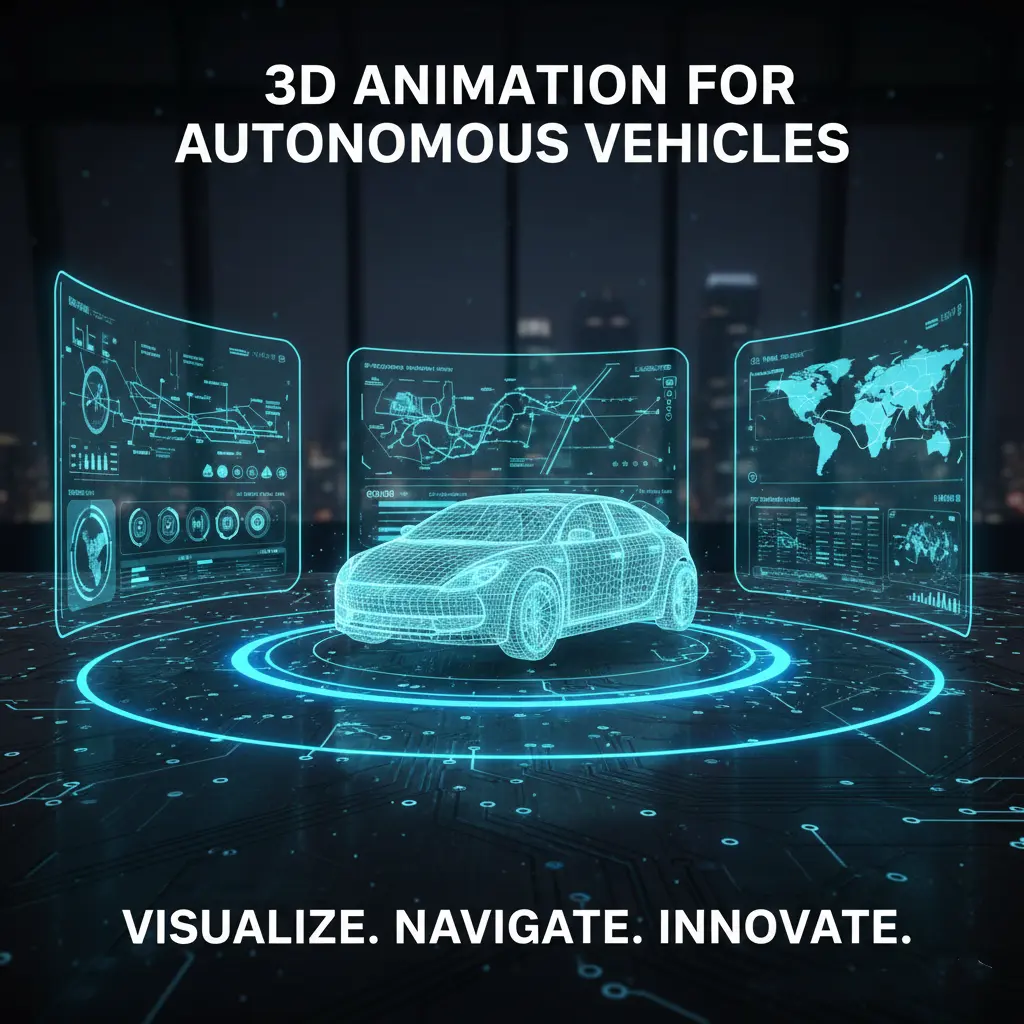
To bridge the Trust Gap, you need to show the world what the car sees. 3D Technical Animation allows you to visualize the artificial intelligence inside the machine. Here is how 3D helps you sell the future of mobility.
1. Visualizing “Sensor Fusion” (The Digital Eyes)
To a passenger, the car just drives. But underneath, cameras, Radar, and LiDAR are working together.
3D animation visualizes this Sensor Fusion.
- LiDAR Point Cloud: Show the world through the car’s eyes a colorful 3D dot matrix detecting distance and shape perfectly.
- Object Classification: Visualize the AI identifying objects instantly: Pedestrian (Red), Cyclist (Yellow), Other Vehicle (Blue).
- The Radius: Show the sensors scanning 360 degrees for 200 meters, seeing things a human driver would miss.
2. Simulating “Edge Cases” (Safety Demos)
You cannot test dangerous scenarios with real people. What if a child runs into the street?
3D simulation allows for risk free Edge Case Testing.
- The Danger: Animate a child chasing a ball into the road.
- The Reaction: Visualize the car’s computer calculating the threat in milliseconds and applying the brakes smoothly before impact.
- Bad Weather: Show the sensors cutting through heavy rain or fog where human vision fails.
3. The Passenger Economy (Interior Experience)
When you don’t need to drive, what do you do? The interior design of autonomous cars is a lounge, not a cockpit.
3D animation sells the experience.
- Swivel Seats: Show the front seats rotating 180 degrees to face the rear passengers for a meeting.
- Entertainment: Visualize the windows turning into augmented reality screens for movies or work.
- Relaxation: Show the lighting dimming and the seats reclining into Sleep Mode for a long commute.
4. Visualizing V2X Communication
Autonomous cars talk to the city (Vehicle-to-Everything or V2X). This is invisible magic.
3D animation draws the connections.
- Traffic Lights: Show the traffic light sending a signal to the car: I will turn red in 5 seconds, allowing the car to slow down efficiently.
- Blind Corners: Visualize the car receiving data from a street camera about an oncoming truck around a blind corner.
- Platooning: Show a fleet of autonomous trucks driving inches apart to save fuel, connected by a glowing data stream.
5. Explaining Levels of Autonomy
Customers are confused by Level 2 vs. Level 4.
3D animation simplifies the hierarchy.
- Level 2 (ADAS): Show the driver’s hands briefly leaving the wheel but eyes staying on the road (Lane Keep Assist).
- Level 4/5 (Full Auto): Show the steering wheel retracting into the dashboard, signaling that the human is now just a passenger.
Conclusion
The future of transportation is autonomous, but it requires a leap of faith from the public. 3D animation provides the transparency needed to build that faith. By visualizing the intelligence, safety, and comfort of your vehicle, you turn fear into excitement.
Multiverzz Studio creates futuristic, sensor accurate 3D animations for the autonomous vehicle and AI industry. Visualize the road ahead. Contact us today.