
Focus on Perfection: 3D Rendering for Eyewear Brands
Eyewear is one of the most difficult products to photograph. Why? Because it is basically a mirror.
Lenses reflect everything the studio lights, the camera, and even the photographer’s reflection. Retouching these reflections out of thousands of photos takes hours and often makes the lenses look fake or flat.
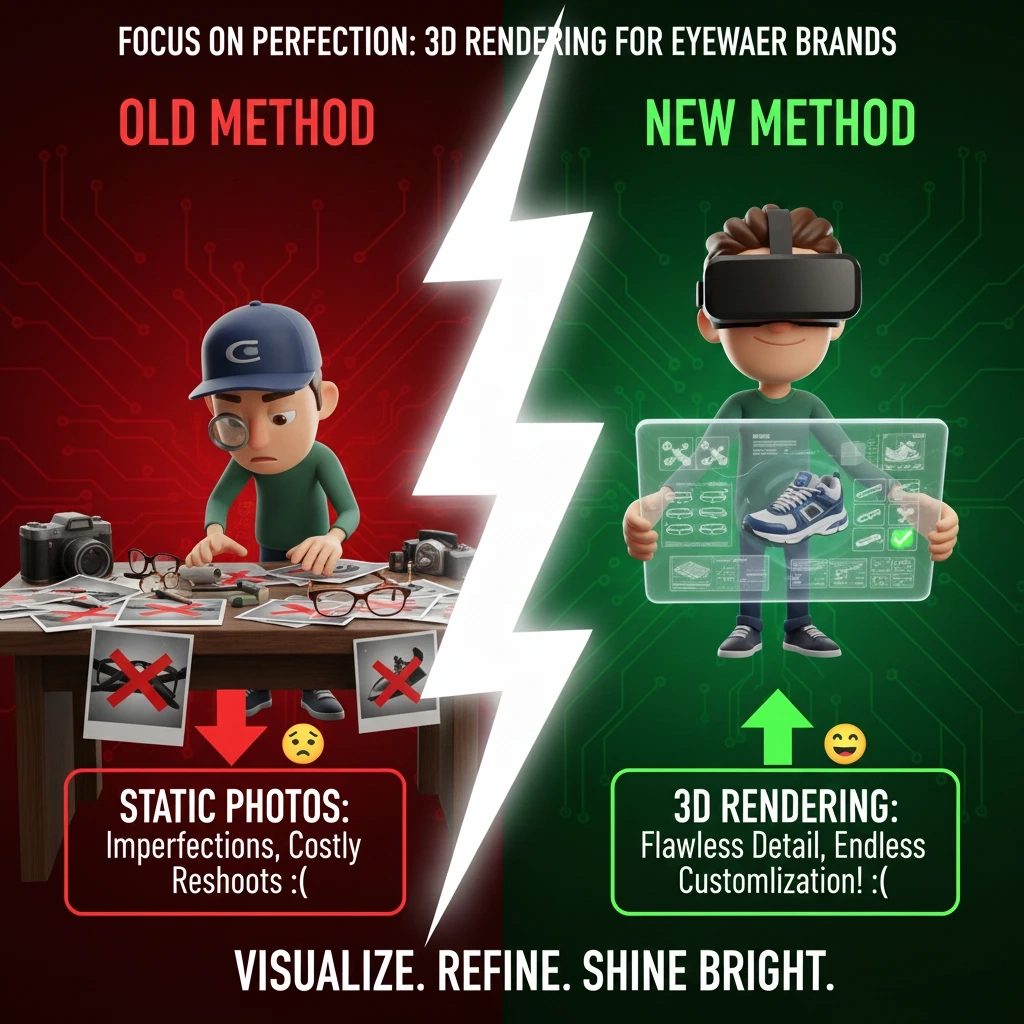
To sell premium eyewear, you need premium visuals. This is why the optical industry is moving towards 3D Product Rendering. Here is how 3D helps you sell frames and lenses faster.
1. Zero Unwanted Reflections
The biggest headache in eyewear photography is controlling reflections. You want the lens to look clear and premium, not cluttered with white softbox squares.
In a 3D environment, we have total control. We can place “invisible” lights that illuminate the frame without appearing on the lens. We can add a perfect, subtle gradient reflection that highlights the curvature of the glass without blocking the product. The result is a pristine, crystal clear image every time.
2. Visualizing Lens Technology
How do you sell “Blue Light Blocking” or “Polarized” lenses? A photo cannot show these invisible features.
3D animation makes the invisible visible.
- Polarization: Show a split screen animation where one side has blinding glare and the “Polarized” side is clear and vibrant.
- Blue Light: Visualize harmful blue laser beams bouncing off the lens, protecting the digital eye behind it.
- Photochromic (Transition): Animate the lens darkening smoothly as a digital sun rises in the background.
3. The Depth of Acetate
High quality acetate frames have depth and transparency. A tortoise-shell pattern isn’t just printed on top; it is embedded inside the material.
Standard photography often flattens this texture. 3D rendering uses “Sub-Surface Scattering” technology to simulate how light penetrates the plastic. This reveals the rich, 3D nature of the pattern, making the frames look expensive and handcrafted.
4. Virtual Try-On (VTO) Ready
The future of eyewear e-commerce is Virtual Try-On. Customers want to use their phone camera to see how the glasses look on their face.
To offer VTO, you need a 3D model. If you use 3D for your marketing images and videos, you are already halfway there. The same high quality asset used for your Instagram ad can be optimized for your AR filter, giving you double the ROI.
5. Infinite SKUs, One Shoot
If you have a frame design that comes in 20 colors and 3 lens types, photographing all 60 combinations is a logistical nightmare.
With 3D, we create the frame once. Then, we can instantly swap the frame color (Black to Gold) or the lens tint (Grey to Amber). This ensures that every single product image on your collection page is perfectly aligned, creating a clean and professional shopping experience.
Conclusion
In the eyewear business, clarity is everything. If your product images have distracting reflections or poor lighting, customers assume the glasses are low quality. 3D rendering gives you the control to present your vision perfectly, frame by frame.
Multiverzz Studio specializes in photorealistic 3D eyewear rendering. Let your customers see clearly. Contact us today.