
Revolutionize Safety Training with 3D Animation
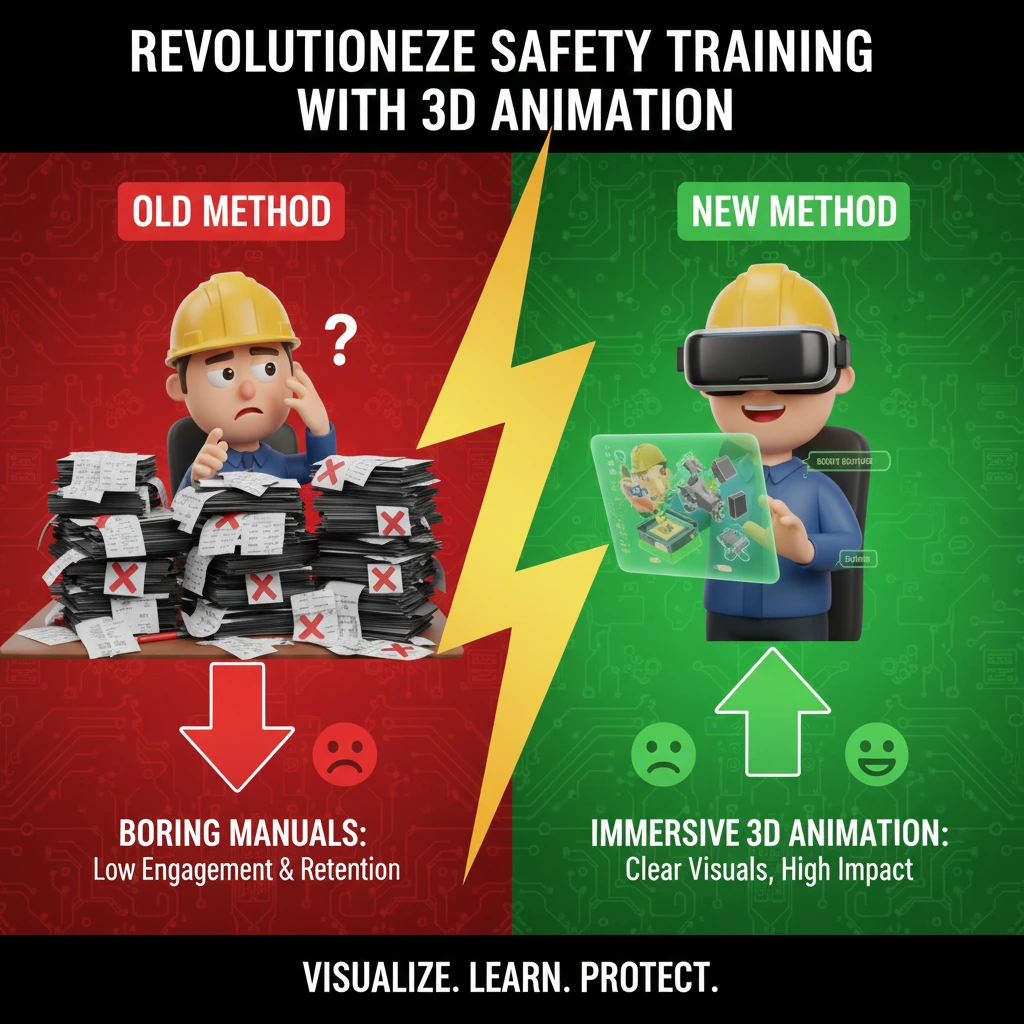
Training new employees on complex industrial machinery is risky and expensive. Traditionally, companies rely on thick manuals, PowerPoint slides, or “shadowing” experienced workers.
However, these methods have flaws. Manuals are boring and often ignored. Shadowing takes a productive employee away from their work. Worst of all, training on live equipment carries real physical danger.
This is why forward thinking companies are adopting 3D Safety & Training Animations. Here is how 3D is making the workplace safer and smarter.
1. Zero-Risk Learning Environment
The biggest challenge in heavy industry (manufacturing, oil & gas, construction) is that mistakes can be fatal. You cannot afford for a trainee to press the wrong button on a high-voltage system just to “see what happens.”
3D animation creates a safe, virtual simulator. A trainee can watch a realistic animation of the machine exploding or malfunctioning due to operator error without any real world consequences. This “shock value” reinforces safety protocols far better than a warning text in a handbook.
2. Visualizing Internal Hazards
Many industrial accidents happen because workers cannot see what is happening inside a machine. They might open a valve thinking it is safe, not knowing high pressure is building up behind it.
3D animation solves this with X-Ray Views.
- Flow Visualization: Show hot steam or toxic chemicals moving through pipes.
- Hidden Danger: Reveal internal gears or blades that are still spinning even after the machine is turned off.
When workers can “see the invisible,” they respect the equipment more.
3. Standardized Training for Everyone
If you rely on human trainers, the quality of training varies. One trainer might be thorough, while another might skip important safety steps because they are in a hurry.
A 3D training video ensures consistency. Every single employee whether in New York or Tokyo watches the exact same procedure, explained perfectly every time. This standardization is crucial for maintaining ISO compliance and quality control across global facilities.
4. Reducing Machine Downtime
Training on real equipment often means shutting down a production line so a new hire can practice. This costs the company money every minute the machine is not running.
With 3D animation, the initial phase of training happens offline. Employees can learn the control panel, the start up sequence, and the emergency stop procedures on a tablet or computer. By the time they touch the real machine, they are already familiar with it, reducing the training time required on the live floor.
5. Overcoming Literacy and Language Barriers
Industrial workforces are often diverse, speaking multiple languages. Technical manuals filled with complex jargon can be misunderstood.
3D animation is a visual language. A video showing a red lever being pulled followed by a green light requires no translation. It bridges the communication gap, ensuring that safety protocols are understood by everyone, regardless of their reading ability or native language.
Conclusion
Safety is not just a checkbox; it is a culture. By investing in high-quality 3D training animations, you protect your most valuable assets your employees and your equipment. It is an investment that pays off in fewer accidents, lower insurance premiums, and higher efficiency.
Multiverzz Studio creates clear, accurate industrial training animations that save lives and costs. Upgrade your safety program today.