
Sell Smart Appliances with 3D Animation
Selling smart home appliances is different from selling standard furniture or decor. When a customer buys an air purifier, a robot vacuum, or a smart thermostat, they are buying a promise of performance.
But here is the problem: you cannot see clean air. You cannot see a thermostat sensing temperature. You cannot see a vacuum mapping a room.
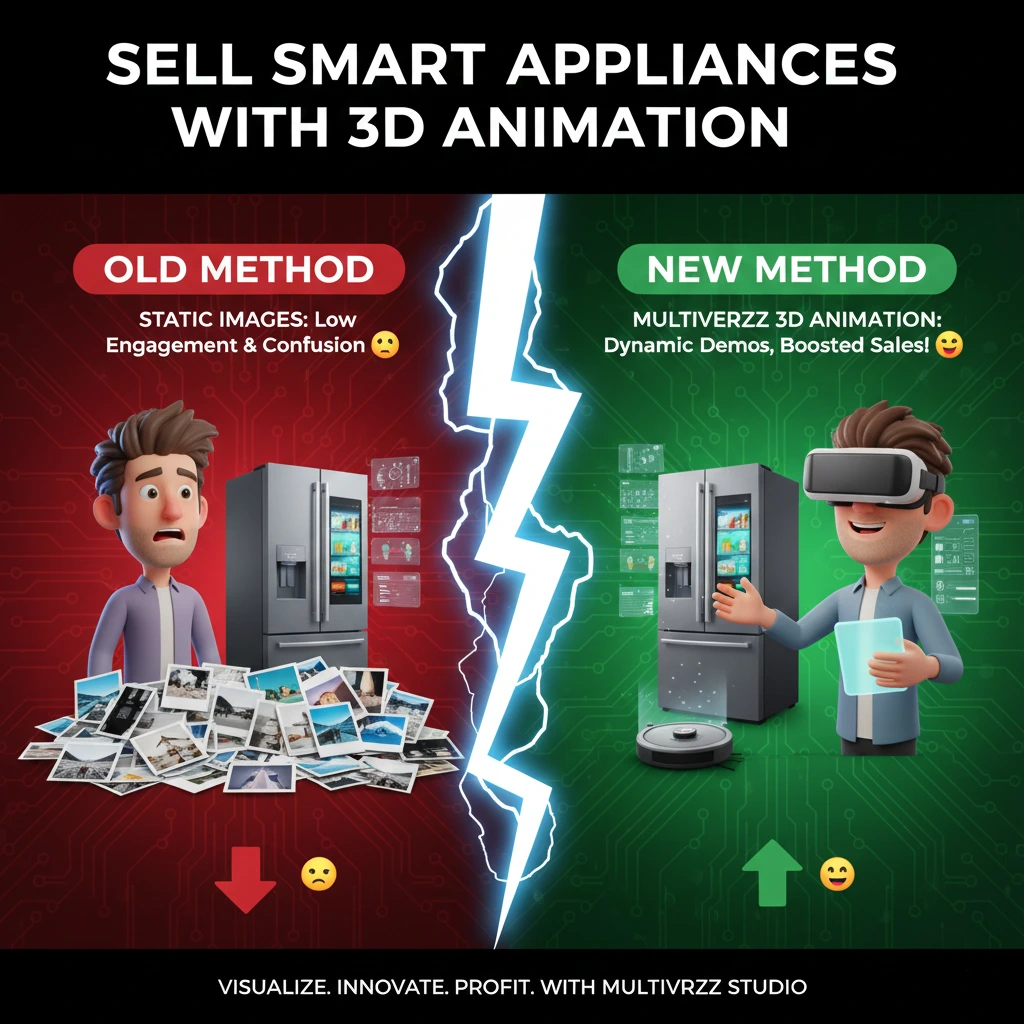
Traditional photography fails to capture the “Smart” in smart devices. To prove your product works, you need 3D Product Animation. Here is how 3D helps you visualize the invisible and drive sales.
1. Visualizing the Invisible (Airflow & Filtration)
For brands selling air purifiers, humidifiers, or AC units, the main selling point is invisible.
3D animation allows you to create Particle Simulations.
- Before: Show the room filled with red dust particles, pollen, and bacteria.
- Action: Show the air being sucked into the device, passing through the HEPA filter layers.
- After: Show clean, blue air circulating back into the room.
This visual transformation proves the product’s effectiveness in a way that a static photo of a white box never could.
2. Explaining Sensor Technology
Smart devices rely on sensors. A robot vacuum avoids stairs, a fridge adjusts cooling based on contents.
How do you show a sensor “thinking”? With 3D motion graphics.
- We can project a digital scanning grid (LiDAR) coming out of the robot vacuum to show it mapping the floor.
- We can show WiFi signals connecting the device to a smartphone app.
By visualizing the data flow, you make the intelligence of the device tangible and valuable to the consumer.
3. Section Views of Advanced Motors
Consumers often associate weight and motor size with power. If your vacuum cleaner has a revolutionary digital motor, hiding it inside plastic is a waste.
An Exploded View or Cutaway Animation can slice through the outer shell to reveal the high-speed copper motor spinning inside. You can highlight the engineering precision, the dual cyclone technology, or the battery placement. This appeals to the technical side of the buyer’s brain.
4. UI/UX Integration
Smart appliances come with apps. A major selling point is controlling the device from your phone.
Filming a phone screen is difficult due to glare and low brightness. In 3D, we can seamlessly composite the App UI onto a floating phone screen next to the product.
- Show the user tapping “Cool” on the app, and instantly animate the AC unit responding.
- This demonstrates the ecosystem and ease of use perfectly.
5. Visualizing Silence
Many modern appliances market themselves as “Ultra Quiet.” But you cannot photograph silence.
3D animation can visualize sound reduction. We can use graphical sound waves that start loud (jagged and red) and become smooth (soft blue) as the “Silent Mode” is activated. This visual metaphor communicates the benefit of a quiet home instantly, even when the user is watching the video on mute.
Conclusion
Smart homes require smart marketing. If your product is advanced, your visuals cannot be basic. 3D animation bridges the gap between complex engineering and consumer benefits, making your appliance the obvious choice for a modern home.
Multiverzz Studio brings smart technology to life with high tech 3D simulations. Let’s visualize your innovation. Contact us today.