
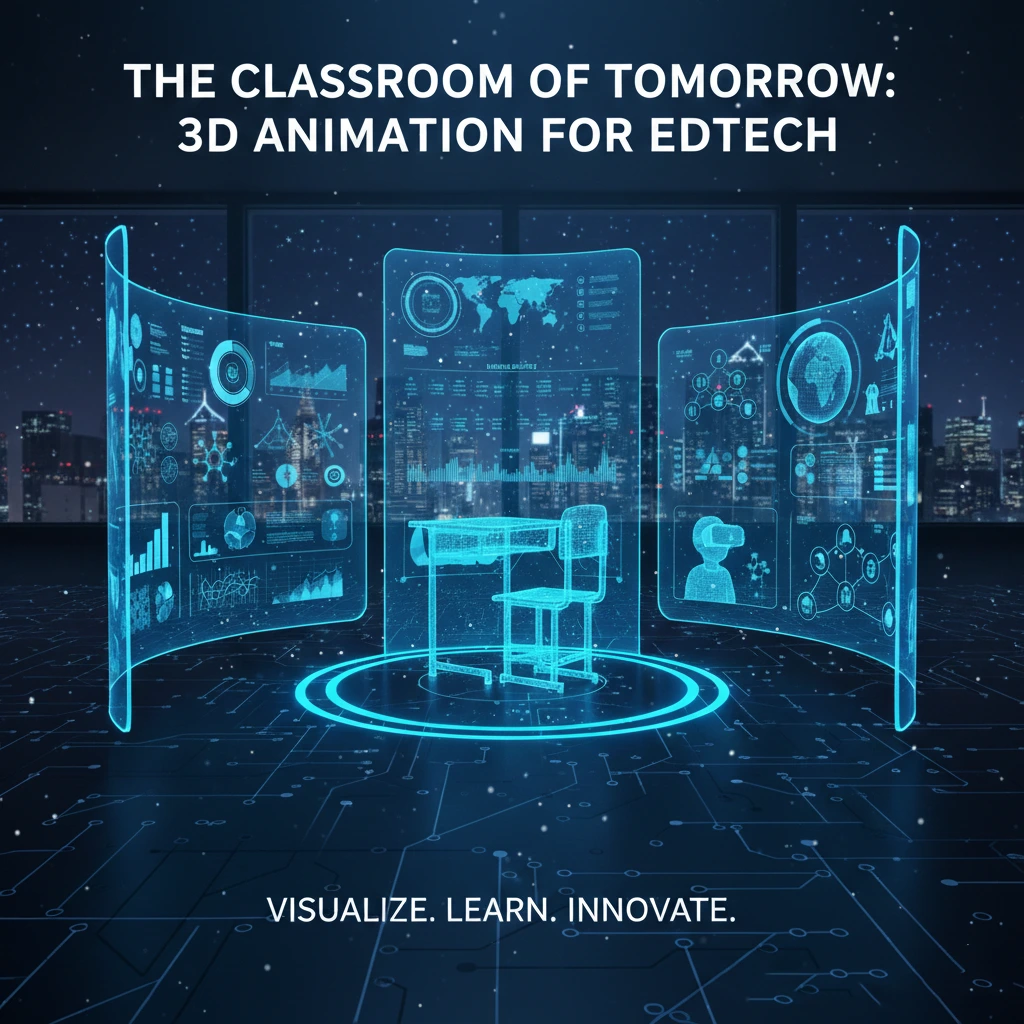
The Classroom of Tomorrow: 3D Animation for EdTech
The education landscape is shifting. Students raised on video games and TikTok find static textbooks boring. Engagement is at an all-time low.
How do you teach complex subjects like Quantum Physics or Ancient History to a distracted generation?
You don’t tell them you show them. 3D Educational Animation is transforming the classroom into an immersive experience. Here is how 3D is rewriting the future of learning.
1. Visualizing the Abstract (Science & Math)
Some concepts are impossible to see with the naked eye. An atom, a DNA strand, or a black hole.
3D animation makes the invisible visible.
- Chemistry: Visualize molecules bonding and breaking apart in a chemical reaction.
- Biology: Travel inside the human bloodstream to watch white blood cells fighting a virus.
- Astronomy: Fly through the solar system to understand the scale of planets relative to the sun.
This turns abstract theory into concrete understanding.
2. Time Travel (History & Archaeology)
History often feels like just memorizing dates. What if students could walk through history?
3D reconstruction brings the past to life.
- Ancient Civilizations: Rebuild the Colosseum in Rome or the Pyramids of Giza to show how they looked in their prime.
- Events: Visualize the sinking of the Titanic or the mechanics of a medieval siege engine.
- Artifacts: Let students inspect a 3D scanned dinosaur bone or a samurai sword from every angle.
3. The Safe Virtual Lab
Chemistry and physics experiments can be dangerous and expensive. Schools often lack the resources for advanced labs.
3D simulation creates a Risk Free Lab.
- Chemical Mixing: Allow students to mix virtual chemicals to see the explosion without burning down the school.
- Physics: Simulate car crashes to teach momentum and friction safely.
- Dissection: Perform a digital frog dissection, saving animals and avoiding the yuck factor.
4. Gamified Learning (Interactive 3D)
Passive watching is good, active participation is better. 3D assets are the foundation of gamified learning.
- Interactive Models: Instead of just watching a heart beat, the student can click to remove layers, rotate the organ, and see the valves working.
- Quizzes: Integrate 3D visuals into quizzes Click on the mitochondria in this cell model.
- Retention: Studies show that interactive 3D learning increases information retention by up to 60%.
5. Accessibility & Visual Learning
Not every student learns by reading. Visual learners struggle with text heavy curriculums.
3D animation democratizes education.
- Universal Language: A visual of a machine working needs no translation. It bridges language barriers.
- Special Needs: For students with dyslexia or attention disorders, dynamic visuals provide a stimulating way to grasp concepts that text cannot convey.
Conclusion
Education is no longer bound by the physical limits of a classroom. 3D animation opens a portal to the microscopic and the majestic. By making learning visual and immersive, we aren’t just teaching students we are inspiring the next generation of scientists, historians, and creators.
Multiverzz Studio creates educational 3D content that sparks curiosity. Let’s build the future of learning. Contact us today.