
Visualize Comfort: 3D Animation for HVAC Brands
Marketing HVAC systems (Heating, Ventilation, and Air Conditioning) creates a unique problem: you are selling invisible comfort. You cannot see cold air. You cannot see heat transfer.
A photo of a white box on a wall tells the customer nothing about efficiency, noise levels, or airflow.
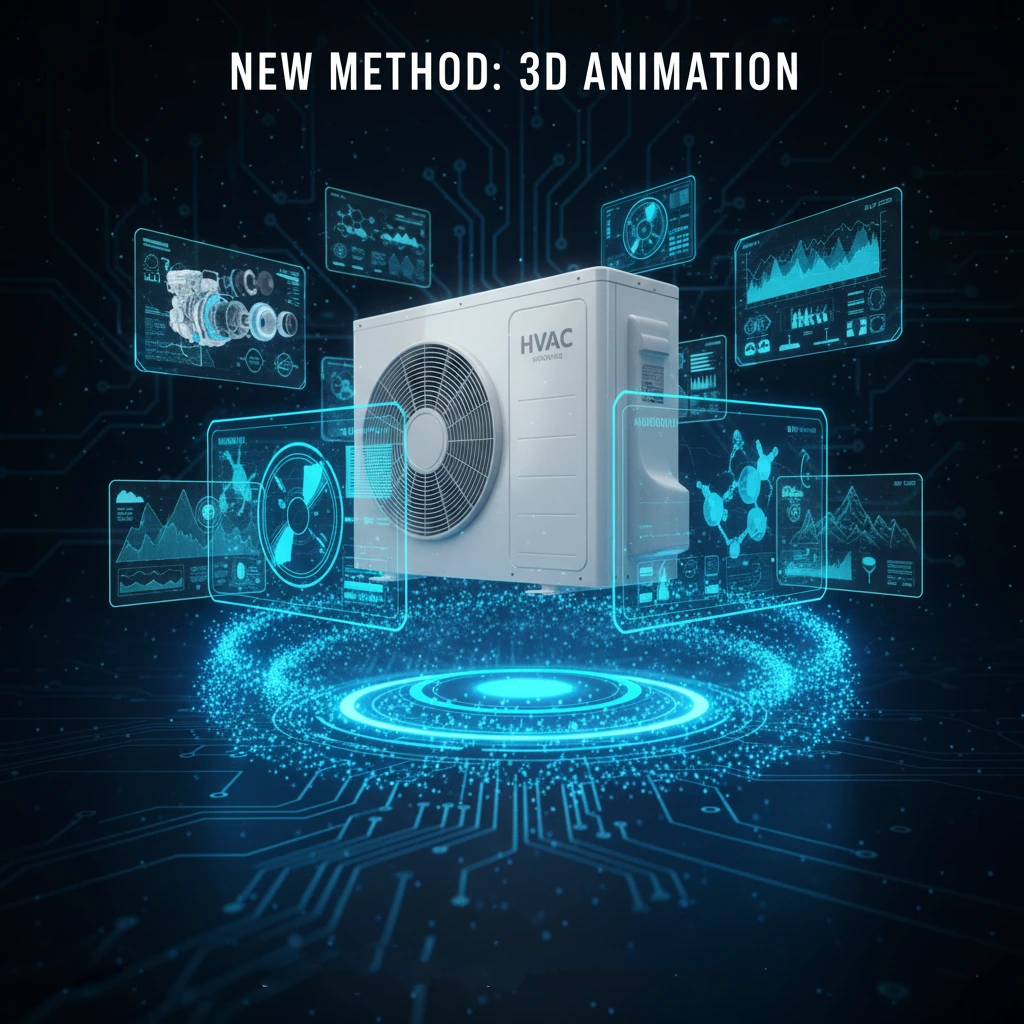
To compete in the modern market, brands like Carrier, Daikin, and Mitsubishi Electric are using 3D Technical Animation. Here is how 3D helps you visualize the invisible science of comfort.
1. Visualizing Airflow Dynamics
The most important feature of an AC unit is how it moves air. Does it cool the whole room evenly? Or just one spot?
3D animation makes air visible.
- Particle Flow: Use blue streams to show cool air reaching every corner of a living room.
- 3D Heat Map: Visualize the room temperature changing from red (hot) to blue (cool) in seconds.
- Wind Free Tech: Show air dispersing through thousands of micro holes to demonstrate draft free cooling.
2. Inside the Compressor (The Heart)
The compressor is the engine of the HVAC unit. Customers pay a premium for Inverter Technology, but few understand it.
3D animation allows for a deep X-Ray Dive.
- The Mechanism: Peel back the metal casing to show the scroll compressor working.
- Variable Speed: Animate the motor speeding up and slowing down efficiently, rather than the “stop start” of older models.
- Magnetic Bearings: Visualize friction free rotation to prove durability and silence.
3. Filtration and Air Quality
Post-pandemic, customers are obsessed with Indoor Air Quality (IAQ). They want to know if your AC kills viruses or filters dust.
You cannot film a virus being filtered. 3D animation simulates the microscopic battle.
- The Pollutants: Show dust, pollen, and bacteria entering the intake.
- The Filter: Visualize the HEPA or electrostatic filter trapping these particles.
- The Result: Show pristine, glowing clean air exiting the unit, proving health benefits.
4. Installation Training & Visualization
Ductless mini-splits are popular, but homeowners worry about the installation mess. Contractors worry about complex wiring.
A 3D Installation Guide serves both audiences.
- Homeowners: Show how the unit mounts cleanly on the wall with minimal drilling.
- Installers: Provide a step by step technical guide on connecting refrigerant lines and drainage, reducing installation errors on-site.
5. Energy Efficiency (The Bill Saver)
“High SEER Rating” is just a number. Customers want to visualize savings.
3D animation demonstrates heat exchange efficiency.
- Thermal Exchange: Show heat being extracted from the indoor air and ejected outside.
- Eco Mode: Visualize the system consuming less power (glowing green) when the desired temperature is reached.
- Comparison: Use a split screen to show your inverter model using 40% less energy than a traditional unit.
Conclusion
HVAC systems are sophisticated machines that improve life quality. Your marketing should reflect that sophistication. 3D animation bridges the gap between complex engineering and the simple desire for a comfortable home.
Multiverzz Studio creates technical and commercial 3D animations for the HVAC industry. Let’s make comfort visible. Contact us today.